Medical billing errors can affect healthcare providers, insurance companies, and patients by creating inaccurate charges, claim rejections, payment delays, and unexpected medical bills. Mistakes involving medical codes, documentation, duplicate charges, and insurance information can complicate the billing process and leave patients responsible for amounts they may not owe.
The DecodeMBCodes team gathered the following medical billing error statistics to examine how frequently billing mistakes occur, which errors are most commonly reported, how coding and documentation affect claim processing, and what financial consequences these problems can have. The figures come from multiple research sources and government reports, with different populations, reporting periods, and definitions.
Key Medical Billing Error Statistics
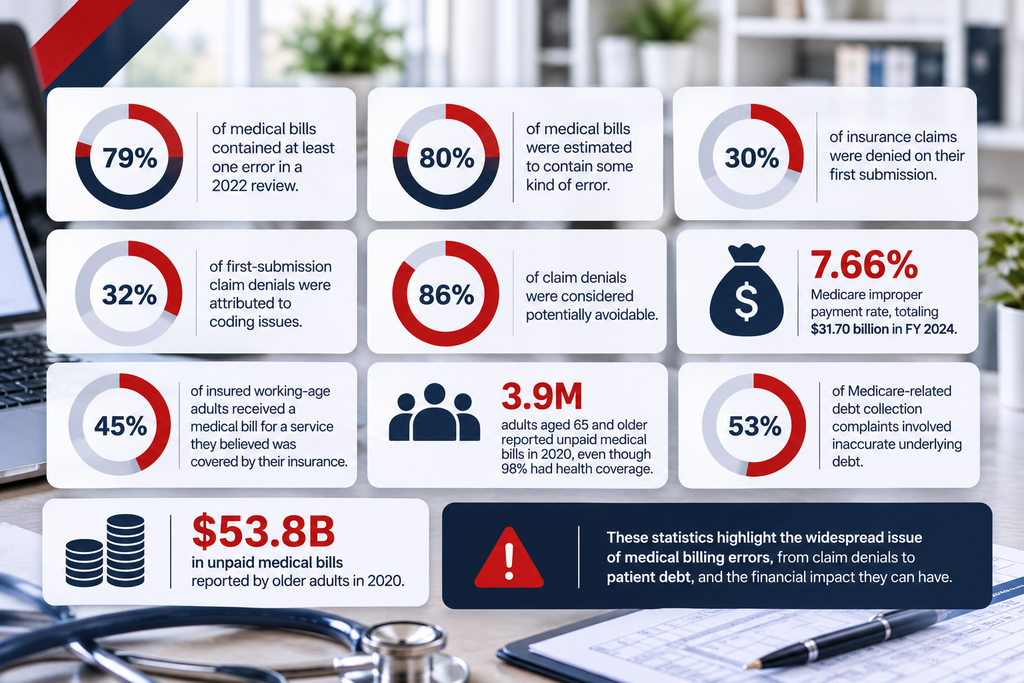
- Approximately 79% of medical bills contains at least one error.
- Around 80% of medical bills were estimated to contain some kind of error.
- Approximately 30% of insurance claims were denied on their first submission.
- 32% of first-submission claim denials were attributed to coding issues.
- 86% of claim denials were considered potentially avoidable.
- Medicare Fee-for-Service had a 7.66% improper payment rate, representing $31.70 billion in FY 2024.
- 45% of insured working-age adults received a medical bill for a service they believed was covered by their insurance.
- Nearly 3.9 million adults aged 65 and older reported unpaid medical bills in 2020, even though 98% had health insurance coverage.
- 53% of Medicare-related debt collection complaints involved inaccurate underlying debt.
- Unpaid medical bills reported by older adults reached $53.8 billion in 2020.
These figures show that medical billing problems extend beyond incorrect charges. Coding and documentation mistakes can affect claim processing, while inaccurate bills may lead to payment disputes and medical debt. However, improper payment rates, insurance denials, and patient billing errors measure different aspects of the healthcare billing system.
How Common Are Medical Billing Errors?
Medical billing errors are frequently reported in studies examining hospital bills, physician claims, and insurance billing practices. However, estimates vary depending on how researchers define an error and which types of medical bills they examine.
- A 2022 review found that 79% of medical bills contained at least one error.
- Around 80% of medical bills were estimated to contain some kind of error.
- A 2021 study found that 80 out of 100 hospital bills contained errors, with an average of $1,891 in errors per bill.
- 70% of patients received bills containing errors after insurance adjustments.
- A 2019 audit identified errors in 92% of emergency department bills examined in a sample of 1,000 claims.
These estimates indicate that billing inaccuracies have been identified across different healthcare settings. However, the figures should not be treated as directly comparable because the studies examined different populations, billing environments, and error definitions. An error also does not necessarily mean that a patient was overcharged, as some mistakes involve coding or documentation that may affect insurance reimbursement rather than the final patient balance.
Common Types of Medical Billing Errors
Medical billing errors can occur at different stages of the billing process, from recording services and assigning codes to submitting claims and calculating patient responsibilities. Some mistakes result in duplicate charges, while others involve incorrect coding or missing information.
- Duplicate charges appeared in 25% of erroneous bills.
- Upcoding was identified in 18% of hospital claims.
- Unbundling was reported in 14% of surgical bills.
- Modifier errors affected 30% of outpatient claims.
- Incorrect CPT codes appeared in 22% of physician claims.
Common medical billing errors include:
- Duplicate billing: Charging for the same service, procedure, or item more than once.
- Incorrect CPT codes: Using an inaccurate procedure code when submitting a medical claim.
- Upcoding: Assigning a code representing a more complex or expensive service than the documentation supports.
- Unbundling: Separately billing services that should be reported together under the applicable billing rules.
- Missing claim information: Submitting claims without required data or with invalid information.
- Documentation errors: Failing to provide medical records that support the services and codes included in a claim.
These mistakes can affect the accuracy of insurance claims and patient statements. Their consequences depend on the type of error, the services involved, and whether the issue is identified and corrected before payment or collection.
Sources: (Gitnux)
Medical Coding Errors and Improper Payment Statistics
Accurate medical coding and supporting documentation are important parts of the healthcare reimbursement process. When submitted codes do not match the medical records or required documentation is missing, insurance claims may be rejected or payments may not meet program requirements.
- 79.11% of Medicaid improper payments in FY 2024 were attributed to insufficient documentation.
- Internal medicine visits had a 14.8% improper payment rate, while 43.9% of sampled claims were coded incorrectly.
- Family practice visits had a 12.3% improper payment rate, with 33.9% of sampled claims coded incorrectly.
- In a sample of 200 claims, 41% were overcoded and 45% were undercoded.
- Inadequate staff training was attributed to 28% of billing errors.
- Poor documentation was associated with 35% of claim denials.
CMS also reported different improper payment rates across federal healthcare programs in FY 2024:
- Medicare Fee-for-Service: 7.66%, representing $31.70 billion.
- Medicare Part C: 5.61%, representing approximately $19.07 billion.
- Medicare Part D: 3.70%, representing approximately $3.58 billion.
- Medicaid: 5.09%, representing $31.10 billion in federal funds.
Improper payments are not synonymous with confirmed billing fraud. They include payments that do not meet program requirements, including cases involving insufficient documentation or other administrative and billing problems. These figures demonstrate why coding accuracy and complete documentation matter when healthcare providers submit claims for reimbursement.
Sources: (Aptarro, PubMed Central, Gitnux)
Financial Costs of Medical Billing Errors for Healthcare Providers
Billing inaccuracies can create additional work for healthcare organizations and affect how efficiently they collect revenue. When claims contain incorrect codes, missing information, or other mistakes, billing teams may need to investigate the issue, correct the claim, and submit it again.
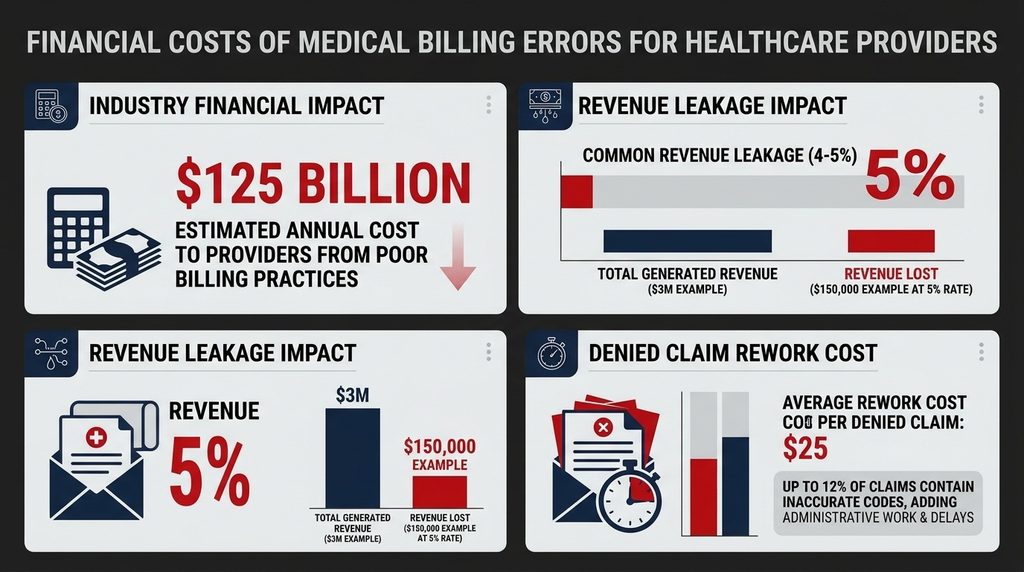
- Poor billing practices were estimated to cost healthcare providers $125 billion annually.
- Healthcare providers commonly lose 4–5% of their revenue through revenue leakage.
- A medical practice generating $3 million annually could lose approximately $150,000 through revenue leakage at a 5% rate.
- Reworking a denied claim can cost approximately $25 per claim in high-denial practices.
- Up to 12% of submitted claims may contain inaccurate codes.
These figures illustrate how billing problems can affect provider revenue beyond the original claim amount. Staff time spent correcting mistakes, resubmitting claims, and following up on delayed payments adds administrative work and can increase operating costs. Revenue leakage estimates and improper payment figures measure different financial issues, so they should not be combined into a single estimate of losses caused by medical billing errors.
Sources: (BillFlash, Aptarro, PCG Software)
Medical Claim Denial and Insurance Billing Statistics
Medical claim denials can occur for several reasons, including coding mistakes, missing documentation, authorization problems, and insurance coverage decisions. Although not every denial is caused by a billing error, problems with claim preparation and submission can contribute to rejected claims and reimbursement delays.
- Approximately 30% of insurance claims were denied on their first submission.
- 32% of first-submission denials were attributed to coding issues.
- 86% of denials were considered potentially avoidable.
- Poor automation and training practices were associated with denial rates of 15–20%, compared with a benchmark of 5–7%.
- 17% of insured working-age adults reported that their insurer denied coverage for a service recommended by a physician.
- Around 60% of people experiencing coverage denials reported delays in receiving care.
- 47% said their health condition deteriorated because of those delays.
- Cigna’s PXDX system denied more than 300,000 payment requests in two months, with an average processing time of 1.2 seconds per case.
Claim rejections and coverage denials should be distinguished. A claim may be rejected because of incorrect coding or missing information, while a coverage denial concerns an insurer’s decision not to approve a requested service or treatment. Both can create difficulties for patients and healthcare providers, but they do not necessarily have the same cause.
Sources: (BillFlash, Aptarro, Commonwealth Fund, ClinicMind)
Medical Billing Errors, Patient Debt, and Billing Disputes
Inaccurate medical bills can create financial difficulties even for patients who have health insurance. Problems involving claim submissions, multiple insurance providers, and incorrect patient balances can result in bills being sent to patients or debt collectors for amounts they may not owe.
- 45% of insured working-age adults reported receiving a bill for a service they believed was covered by their insurance.
- In 2020, 3.9 million adults aged 65 and older reported having unpaid medical bills.
- 98% of those older adults had health insurance coverage.
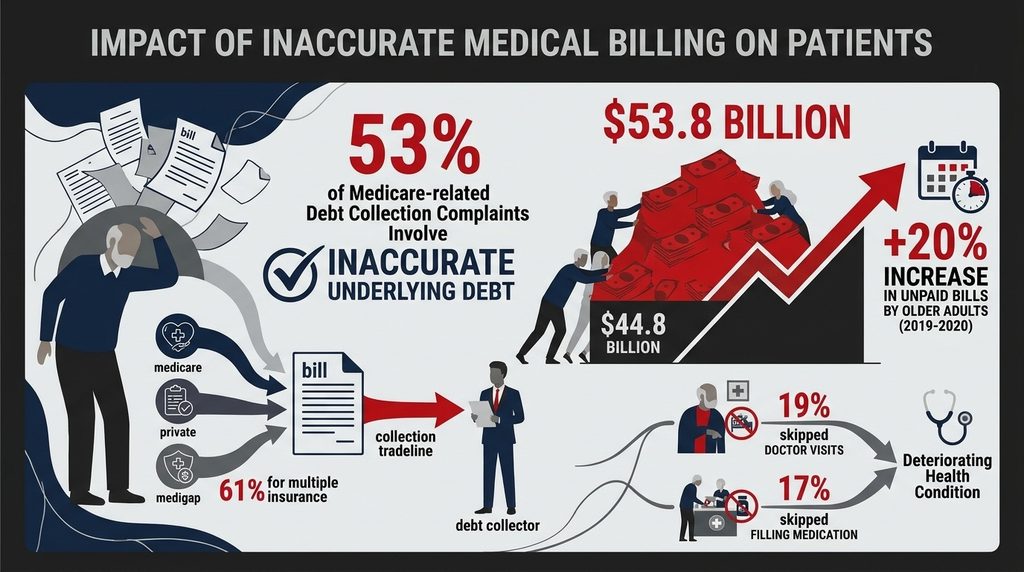
- The total amount of unpaid medical bills reported by older adults increased 20%, from $44.8 billion in 2019 to $53.8 billion in 2020.
- 53% of Medicare-related debt collection complaints involved inaccurate underlying debt. Among people with more than one source of insurance, the figure increased to 61%.
- As of December 2020, 5.1 million older adults had approximately $7.97 billion in medical collection tradelines on their credit reports.
- 19% of older adults with medical debt reported skipping doctor visits, while 17% chose not to fill prescribed medication.
Billing Issues Involving Multiple Insurance Policies
The CFPB findings highlight the complexity of billing for patients with multiple insurance policies. Older adults may rely on Medicare alongside Medicaid, Medigap, employer-sponsored coverage, or other insurance. If a provider fails to submit a claim to the appropriate insurer or incorrectly calculates the patient’s responsibility, an inaccurate balance may remain unpaid or be referred to collections.
How Medical Billing Problems Affect Patients
The financial consequences can extend beyond the original bill. Inaccurate medical collection information may affect access to credit, while the effort required to dispute charges can create additional stress for patients.
Older adults with both Medicare and Medicaid reported unpaid medical bills at a higher rate than the general older population: 10% compared with 7%.
Not All Medical Debt Results From Billing Errors
Not all medical debt results from billing errors. Deductibles, cost-sharing, uncovered services, and limited household income can also contribute to unpaid medical bills. Nevertheless, the CFPB findings demonstrate that inaccurate billing can be part of the problem, including for people with extensive insurance coverage.
Sources: (Commonwealth Fund, ClinicMind, Consumer Financial)
Conclusion
Medical billing error statistics show that inaccuracies in coding, documentation, claim submission, and patient billing can affect healthcare organizations and patients in different ways. For providers, these problems can contribute to claim denials, administrative rework, delayed reimbursement, and revenue losses. For patients, inaccurate bills may lead to unexpected balances, disputes, and medical debt, even when insurance coverage is available.
The findings also highlight the importance of accurate medical coding, complete documentation, and correct insurance billing. Identifying and addressing errors can help reduce unnecessary billing complications and prevent patients from being pursued for amounts they do not owe.